
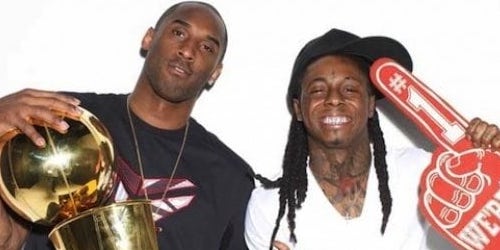

“Kobe doin’ work, two four on my shirt / he the greatest on the court and I’m the greatest on the verse.” – Lil Wayne, “Kobe Bryant”
On Sunday, the world was shocked to learn of the devastating passing of Kobe Bean Bryant after he was involved in a helicopter accident in Southern California. He was only 41 years old. His 13-year-old daughter, Gianna (Gigi), as well as seven others were also aboard and did not survive. Like her father, Gigi was a budding basketball talent, and the passengers were on their way to a travel basketball game.
Our prayers and deepest sympathies go out to all the families involved. 😢😢
After entering the NBA straight from high school, Kobe played for the Los Angeles Lakers for 20 seasons. He’s one of the most decorated players in the history of the league and is regularly mentioned in debates about “Who’s the 🐐?” Some of his finest accolades include: 18x NBA All-Star, 5x NBA champion, 2x NBA Finals MVP, NBA regular season MVP, Slam Dunk Contest Champion and much more. He’s also the only person ever to have two jersey numbers retired by a team: The Lakers hung his No. 8 and No. 24 in the rafters in 2017.
Beyond his legendary status on the court, Kobe was an enthusiastic and loving husband and dad, a dedicated businessman and venture capitalist, an ambitious producer and Oscar winner…the list goes on.
There are two other titles he earned that may be overlooked, though: rapper and leading source of hip-hop inspiration.
Yes, Kobe was once signed to Sony Entertainment as part of a hip-hop group called CHEIZAW in the late ’90s. According to Grantland, which published an awesome, in-depth look at Kobe’s rap career in 2013, the group was formed during his high school days at Lower Merion in Philadelphia. It was originally put together by friend and crew leader Anthony Bannister, who then added local rappers Broady Boy, Kevin “Sandman” Sanchez and Jester to the mix.
When he wasn’t playing ball, Kobe was bouncing around Philly with the rest of CHEIZAW as they battled other rap groups. Though Kobe didn’t usually hop in the battles, he had some promising lyrical skills and would drop bars behind-the-scenes, like in the Lower Merion lunchroom. “Kobe was nice, man. He was lyrical. I wouldn’t have put him in the group if he wasn’t,” Bannister recalled.
Fast forward to the late ’90s and Kobe’s basketball career is exploding as a young player on the Lakers. Steve Stoute, an accomplished music executive who was president of urban music for Sony Entertainment at the time, heard Kobe rhyme one night at a studio session and signed Kobe and CHEIZAW with the hopes that the surrounding group would eventually fizzle. “I just felt like, I’m going to sign the group and slowly but surely I’m sure they would all fall out and we would have a Kobe record,” Stoute said.
Following in the footsteps of his larger than life Lakers teammate, Shaquille O’Neal, who had released four studio albums by the late ’90s (one went platinum, another went gold), Kobe’s brief discography started to take form. In fact, one of his first features was alongside Shaq on “3 X’s Dope,” produced by legendary DJ and beatmaker Clark Kent, which appeared on O’Neal’s 1998 album Respect. Though his name wasn’t officially listed on the original track, Kobe kicks off the record with some surprisingly introspective rhymes, “All these destinations, with split-second acceleration / in a capsule of time to witness your own evaporation.”
Bringing his notorious work ethic into the booth, Kobe added a couple of verses to remixes of Destiny Child’s iconic “Say My Name” and Brian McKnight’s “Hold Me.” He even got a low-key 50 Cent to appear on a remix over The Notorious B.I.G.’s “Who Shot Ya?” Then, in preparation for what was supposed to be his debut album, Visions, Sony and Kobe dropped a very underwhelming single, “K.O.B.E.,” featuring Tyra Banks on the hook. As part of a lofty promotional plan that never really came to fruition, Kobe and Tyra performed the song at NBA All-Star Weekend in January 2000.
On top of a disastrous reception from the public, there was a growing disagreement between Kobe and Sony around style – Kobe wanted to make more lyrical music; Sony was pushing for a pop route. So less than a year after Tyra sang, “K-O-B-E, I L-O-V-E you,” Visions was scrapped and Kobe was dropped from Sony.
While his career as an artist didn’t pan out, Kobe went on to indirectly cement his place among hip-hop’s A-list – not as a peer, but as a go-to source of inspiration. Given his basketball dominance, Kobe was increasingly paired with the foundational themes of superiority and success across hip-hop music. His presence was especially palpable in the late 2000s and early 2010s when he grew his championship ring collection from three to five.
During this era, Kobe was being name-dropped by artists like Kanye West, Drake, Kendrick Lamar, J. Cole, Asher Roth and many others. If you were a high school basketball player in 2012, you’d be hard-pressed to find a warm up playlist that didn’t include Chief Keef declaring, “I been ballin’ so damn I swear I think that I’m Kobe.” And this Juicy J flex on “Errday” with Wiz Khalifa is one of my personal favorite Kobe lines: “My mansion sittin’ on 40 acres, who da neighbors? / Kobe Bryant from the Lakers, now that’s paper!” He even starred alongside Kanye in a hilarious Nike commercial.
To this day, if you come across the punchline setup, “ballin’ like I’m ______,” chances are good that ‘Kobe’ will be the insert. It just has a certain ring to it. Related mentions can be heard more recently from Young Thug, Lil Uzi Vert and ScHoolboy Q.
Yet the No.1 nod to Kobe comes from an artist who was also at the peak of their game circa 2009: Lil Wayne. Fresh off his opus, Tha Carter III, which sold over 3,000,000 copies in the U.S. alone, Mixtape Weezy memorialized The Black Mamba’s magnificence on “Kobe Bryant.” Chopped up with audio clips of Stephen A. Smith, LeBron James and a few others professing their admiration for Kobe, Wayne highlights his own championship-level ability across FOUR unrelenting verses. “And I prefer the ball with 3 seconds / and I bet we gon’ win it all in 3 seconds, ya dig / that is a guarantee apparently / and please tell your defense don’t ever man to man with me,” Wayne spits.
When asked about the song in an interview with The Corp, a podcast hosted by Alex Rodriguez and Barstool’s Big Cat, Kobe said that Lil Wayne called him after a playoff game to let him know how motivated he was after watching his performance. In response to Wayne asking whether it’d be cool if he made a song about him, Kobe shrugged and said, “Aight, cool.”
Within the hip-hop vernacular, similar to many aspects of his life, ‘Kobe’ and ‘success’ have become interchangeable. Picking from a bag of infinite motivation, he once said, “When you make a choice and say, ‘Come hell or high water, I am going to be this,’ then you should not be surprised when you are that.” By putting his all into basketball, his favorite form of creative expression, Kobe in many ways became the rap star he once set out to be.
No wonder he wasn’t surprised when Lil Wayne asked to make a song about him…
Thanks for the memories, motivation and music, Mamba. 💛💜
Read About It is pushing through the trash to put you in tune with what’s poppin’ across hip-hop, from Freddie Gibbs to Future. Subscribe to our mailing list to be among the first to know when we release our weekly content (w)rap-ups.
 Read About It By Gerard Smith
Great loss, great article and insight’😎
LikeLiked by 1 person
What’s up, yeah this post is genuinely pleasant and I have learned lot of things from it
about blogging. thanks.
LikeLiked by 1 person